Separate listings, your own posts, and earned references
A business listing helps people verify the company’s details. A post on your own LinkedIn page can introduce a new resource to an existing audience. An independent publisher may choose to cite that resource because it helps its readers. These are different kinds of links, with different levels of editorial involvement. Record them separately when reviewing a local SEO effort.
Social platforms may qualify outbound links, and neither a published post nor a directory entry guarantees a ranking change. A useful first question is whether a prospective customer could encounter the link in a sensible context. That keeps the work tied to discovery and trust rather than a growing spreadsheet of unrelated domains.

Choose something a local reader can actually use
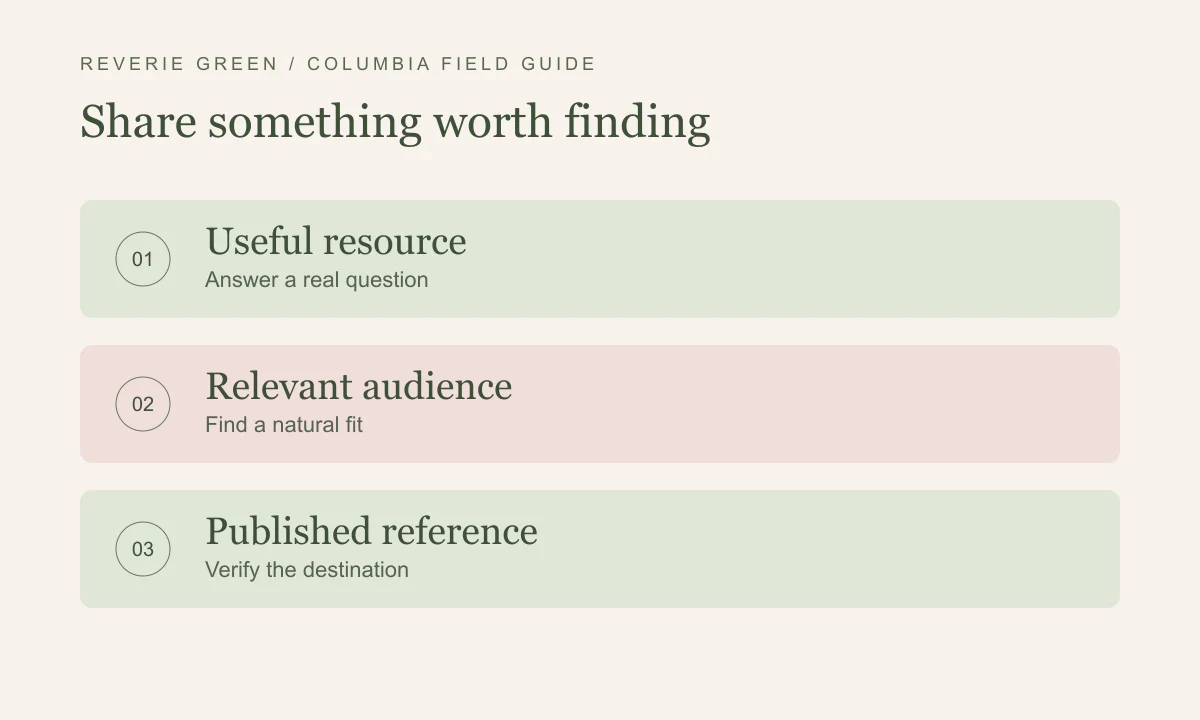
For a Columbia service business, a strong resource might be an accurate first-visit guide, a practical project-planning checklist, or an explanation of a question customers regularly ask. Identify who the resource helps and what they can do after reading it. Keep the useful information available without requiring an email address just to see the answer.
Reverie Green’s Business Profile checklist and service-area page guide are examples of resources for owners making website decisions. A community business newsletter could reference a relevant checklist when answering a reader’s question. Publication remains the editor’s decision; creating a resource gives you something worthwhile to suggest.
Review the relationships the business already has
List professional associations you actually belong to, suppliers you work with, collaborators, event organizers, and organizations where you have a genuine role. Check whether a public member listing or existing partner page is accurate and whether it includes a useful website link. A legitimate listing should describe the relationship truthfully.
For Columbia and Howard County businesses, relevance can come from the audience, the service, or the actual local relationship. Membership, sponsorship, eligibility, and cost should be checked before committing. A request to build local links does not require purchasing memberships or inventing affiliations to fill a directory quota.
Make an editorial suggestion with a specific reason
Read the intended page or publication before contacting its editor. Identify a current resource section or a question their audience is asking. A helpful note explains why your resource fits that context, gives its exact URL, and leaves the decision to the person responsible for the page. Use a small number of relevant suggestions rather than sending an identical pitch to unrelated sites.
For example: “I noticed your business resource page covers getting started online. We published a checklist for Columbia owners checking their Business Profile and website details. If it would help your readers, you’re welcome to reference it here: [resource URL].” Replace the example with the actual page and reason. Do not imply a relationship, endorsement, or prior conversation that did not occur.
Let the publisher choose a natural description
A link labeled Business Profile checklist tells a reader what to expect. Requiring every publisher to use the exact phrase local SEO Columbia MD makes the arrangement less natural. The page itself should explain its subject; the link should fit the surrounding sentence and help the reader decide whether to follow it.
Google’s link-spam guidance covers arrangements intended to manipulate rankings, including certain paid links and excessive exchanges. If promotion is paid, disclose it and follow the applicable link qualification requirements. Keep editorial outreach focused on useful material and leave another site’s publishing standards intact.
Keep a small, verifiable link record
For each suggestion, record the destination resource, intended audience, reason for the fit, contact date, and outcome. After publication, open the actual page and verify the link destination. A draft, an accepted submission form, or a social composer with a preview is not a published link. Check the visible page before marking the placement complete.
Record whether the link is a business citation, an owned social placement, or an independently chosen editorial reference. Where referral measurement is available, review visits and useful inquiries alongside the placement. A publisher’s link attributes and indexability can change, so avoid presenting a one-time check as a permanent guarantee.
Keep the destination worth recommending
Update the resource when its instructions change. Preserve the URL when the subject stays the same, and use a relevant redirect if it genuinely moves. Repair broken images and references, keep the reading experience comfortable on a phone, and make it easy to find the related service without interrupting the useful content.
Start with one resource and a few relationships you can explain. Learn which questions readers ask, improve the material, and repeat the work where there is a clear fit. Local SEO is easier to sustain when the website, business facts, and outside references all describe the same real operation.
What to carry forward
- Distinguish business citations, owned posts, and earned editorial links.
- Create a useful resource before suggesting it to a publisher.
- Verify the actual published page and destination.
- Measure referral interest and inquiries separately from search rankings.